 Skip-the-line available
 Palladio and the World's Oldest Perspective Stage
How Andrea Palladio's final design and Vincenzo Scamozzi's illusionistic streets of Thebes made the Teatro Olimpico a Renaissance masterpiece.
Step inside the Teatro Olimpico and you meet two geniuses at once: Andrea Palladio, who designed it, and Vincenzo Scamozzi, who gave it the oldest surviving stage set in the world.
A Roman Theatre Reborn Indoors
The Teatro Olimpico was Andrea Palladio's final work, begun in 1580, the year he died. By then Palladio was the most celebrated architect in the Veneto, the man who had reshaped Vicenza with his palaces and given the countryside its serene villas. The commission came from the Accademia Olimpica, a learned society of Vicenza's noblemen and scholars, who wanted a permanent home in which to stage the tragedies of the ancient world. Palladio had spent decades studying the ruins of imperial Rome, measuring the great open-air theatres of antiquity and illustrating the plays of Terence. Here, at the very end of his life, he was asked to do something the Romans had never quite done: bring that whole architectural world under a roof. What he designed was, in essence, a classical theatre translated into a Vicentine hall. The semicircular ancient auditorium became a tight semi-ellipse to fit the rectangular building the Academy had been given. The soaring stone stage front of Roman theatres became a wall of columns, niches and statues. Everything the eye met was drawn from the vocabulary of antiquity Palladio had spent his career recovering and refining. He did not live to see any of it built in wood and stucco. He died within months of the foundation being laid, leaving drawings, a vision, and an Academy determined to finish what he had started. The theatre we walk into today is therefore both a beginning and an ending: the culmination of a lifetime spent decoding Rome, and the last statement of an architect who changed the look of Western building more profoundly than almost anyone before or since.
Scamozzi and the Streets of Thebes
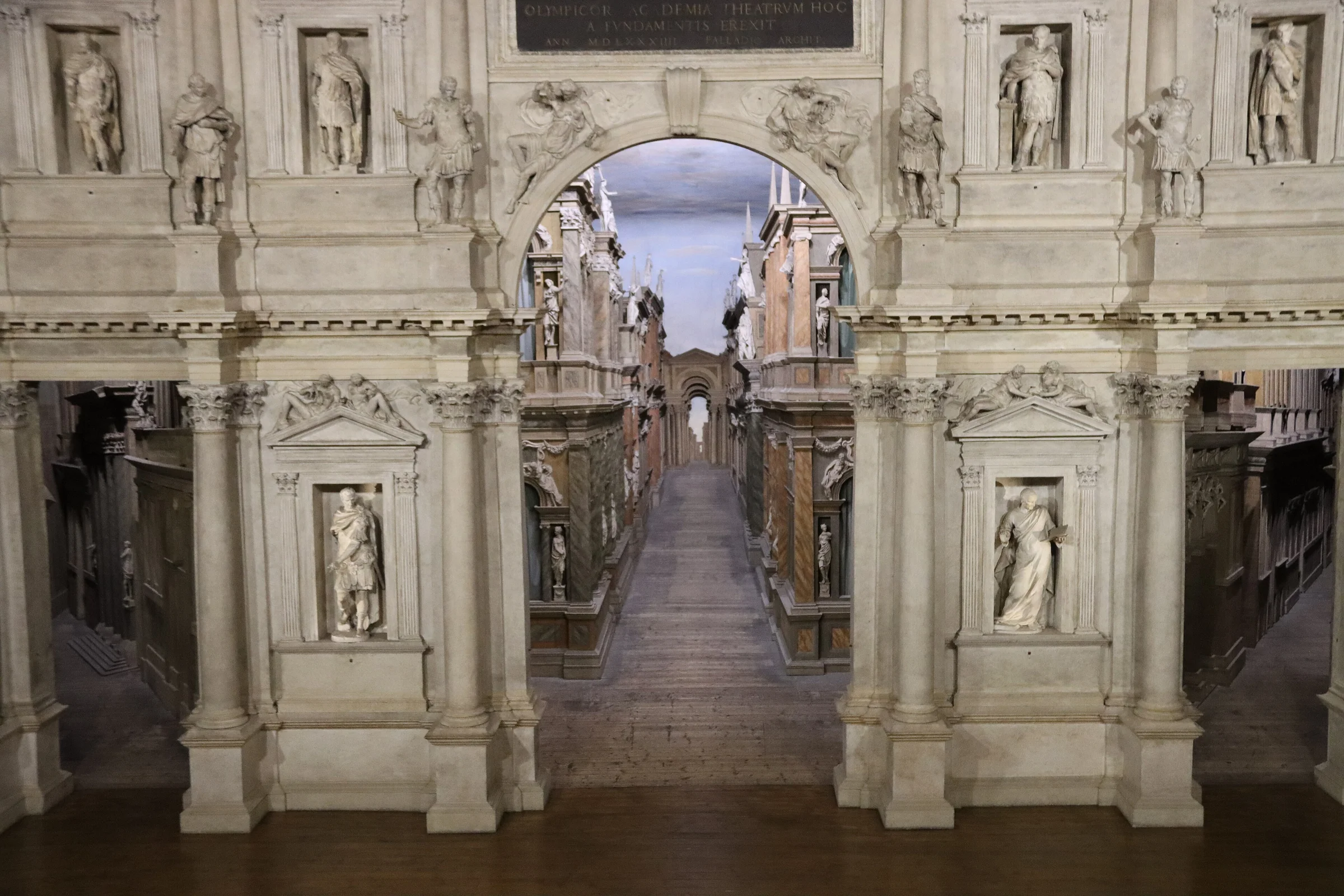
When Palladio died, the Academy turned to Vincenzo Scamozzi, a younger Vicentine architect who would carry the project to its triumphant opening. Scamozzi's task was not merely to complete the shell but to solve the problem Palladio's design had posed: what to put behind the great columned stage front. His answer became the theatre's crowning glory. For the inaugural production, Sophocles' tragedy Oedipus the King, staged in 1585, Scamozzi built a permanent set of the streets of the ancient city of Thebes. Behind the central archway and the side doorways of the stage wall he raised a warren of wooden buildings, palaces, facades and receding alleys, all rendered in painted trompe-l'oeil so convincingly that they read as a real city stretching away into the distance. This is the detail that makes visitors gasp. It is not scenery that was struck and stored after opening night. It has never come down. Built to be permanent from the outset, it has stood on the stage of the Teatro Olimpico for well over four centuries, which makes it the oldest surviving stage set anywhere in the world. Scamozzi designed it specifically for that first Sophoclean tragedy, and the choice of Thebes was no accident: it is the doomed city of Oedipus, and the audience of Vicentine humanists would have recognised every classical reference. What survives is therefore doubly precious. It is a masterpiece of Renaissance stagecraft, and it is a frozen moment of theatrical history, the actual set that greeted the very first audience, still waiting on the boards for a play that ended more than four hundred years ago.
How the Forced Perspective Fools the Eye
The magic of Scamozzi's streets is not paint alone; it is geometry. The illusion is built from forced perspective, a technique that manipulates scale and angle so a shallow space appears to plunge far into the distance. In reality the false streets behind the stage wall are only a few metres deep. Yet stand in the auditorium and they seem to run for hundreds, disappearing toward some far-off square. Scamozzi achieved this by steeply raking the floors of his little streets, tilting them sharply upward as they recede, and by shrinking the buildings, doorways and cornices as they go, so that each successive facade is smaller than the one before. The rows of columns and windows converge toward vanishing points exactly as they would in a painting, except that here the trick is carried out in three dimensions, in real wood and plaster. The result is a theatre of the eye: a compact backstage space that masquerades as a sprawling classical city. Renaissance designers were newly intoxicated by linear perspective, the mathematics of depicting depth on a flat surface, and Scamozzi took that flat-canvas science and stood it up into solid architecture. Because the perspective is calculated from the sightlines of the seated audience, the illusion is strongest from the centre of the cavea, where the streets align most perfectly, though it holds remarkably well across the whole house. Look closely and you can begin to catch the deception, the exaggerated slope of a roadway, the sudden smallness of a distant door, but the first impression is overwhelming. It is one of the earliest and most complete surviving demonstrations of theatrical perspective ever built, and it still works.
The Frons Scenae: A Wall of Statues
Framing those illusionistic streets is the frons scenae, the monumental stage front that Palladio conceived and Scamozzi realised. It is one of the most sumptuous surfaces in Renaissance architecture. Modelled on the elaborate stage walls of Roman theatres, it rises in two ornamented storeys of paired columns, deep niches, richly carved cornices and framed relief panels, and it is crowded, almost overwhelmingly, with statues. Dozens of sculpted figures stand in the niches and along the entablatures, gazing down over the stage. They represent the members of the Accademia Olimpica themselves, portrayed as classical heroes and orators in the guise of antiquity, a learned society casting itself in Roman marble. The wall is pierced by five openings: a grand central arch, framed by columns, and smaller flanking doorways, and it is precisely through these that Scamozzi's perspective streets are glimpsed, so that the architecture becomes a proscenium for the city beyond. The effect is theatrical before a single actor appears. Every element is drawn from the language Palladio spent his life perfecting, the ordered columns, the harmonic proportions, the balance of solid and void, but here it is turned up to a festive, ceremonial pitch. Reliefs above the doorways depict the labours of Hercules, a fitting classical prelude to tragedy. Standing before it, you understand that the Teatro Olimpico is not a neutral container for performance. The building is itself the first spectacle, a permanent set of learned antiquity that would have flattered and awed the Vicentine elite who commissioned it, and that still stops visitors in their tracks the moment they enter the auditorium.
The Cavea and the Painted Sky
Turn away from the stage and the second half of Palladio's design surrounds you. The auditorium is a cavea, the tiered bank of seating of an ancient theatre, here compressed into a semi-elliptical sweep of wooden steps that rise steeply toward the back of the hall. Because the Academy's building was rectangular rather than the great open bowl of a Roman theatre, Palladio flattened the classical semicircle into a shallower ellipse, a clever adaptation that keeps every spectator facing the stage while fitting the room he was given. The tiers are crowned by a colonnade, a screen of columns running along the top of the seating, and above and between these columns stands another population of statues, so that the audience is watched over from every side by classical figures. Then there is the ceiling. Rather than leaving a plain roof over this indoor theatre, the sky itself was painted overhead, a soft expanse of cloud and open air stretching above the cavea. The illusion is deliberate and complete: the roofed hall is disguised as an open-air Roman theatre beneath a real sky, so that spectator and stage seem to sit under the heavens of antiquity rather than under a Vicentine roof. It is the same instinct that drives Scamozzi's streets, the whole building conspiring to convince you that you have stepped out of the sixteenth century and into the classical world. Restrained where the stage front is exuberant, the cavea provides the calm, ordered frame from which the eye is drawn inexorably forward, through the arches, into the impossible receding streets of Thebes.
The Oldest Surviving Indoor Theatre
For all its beauty, the Teatro Olimpico's deepest claim on our attention is historical. It is the oldest surviving indoor, roofed theatre in the world, and one of only three surviving Renaissance theatres anywhere. In an age when performances were staged in temporary structures, courtyards and adapted halls, the Academy of Vicenza built something meant to last, a permanent, purpose-designed playhouse that has come down to us essentially intact. That survival is what turns architecture into a time machine. The stage front Palladio designed still stands as he conceived it; the perspective streets Scamozzi raised for the 1585 Oedipus still recede behind the arches; the painted sky still arches over the cavea. Very little of the Renaissance's built world of theatre survives at all, which makes this fragile ensemble of wood and stucco extraordinarily precious. It is no wonder the theatre forms part of the UNESCO World Heritage Site the City of Vicenza and the Palladian Villas of the Veneto, honoured alongside the palaces Palladio scattered through the city and the villas he set in the surrounding countryside. And it is not a museum-piece frozen behind ropes. The Teatro Olimpico remains in occasional use for performances, so that Scamozzi's centuries-old set can still, on the right evening, hold a living audience exactly as it held the first one. To stand in the cavea is to occupy the same sightlines, look through the same arches and see the same illusory city that Vicenza's noblemen saw when the theatre opened. Few buildings collapse the distance between past and present so completely, or reward a visit with so pure a sense of touching the origins of Western theatre.
Palladio's City and His Final Statement
The Teatro Olimpico does not stand alone. It is the last note in a symphony Palladio composed across an entire city. Vicenza is Palladio's city in the most literal sense: he spent his working life here, and its centre is lined with the palaces he designed, from the great arcaded hall of the Basilica Palladiana overlooking the Piazza dei Signori to the noble facades that give the Corso Palladio its name. Just outside the walls stands his most perfect and most imitated building, the Villa La Rotonda, a domed, symmetrical villa that would echo through country houses and public buildings for centuries afterward, and nearby the frescoed Villa Valmarana ai Nani. To arrive at the theatre at the eastern end of the historic centre is to arrive at the summit of this life's work, the place where the architect who had recovered the language of Rome for palaces and villas finally turned it to the stage. Understanding that context deepens everything you see inside. The frons scenae is not an isolated flourish but the same classical grammar Palladio used on his facades, raised to a theatrical pitch. The proportions, the columns, the balance of ornament and restraint all belong to the vocabulary visible throughout the city. Seen this way, the Teatro Olimpico is both a building and a testament: the closing statement of the most influential architect in the Western tradition, completed by a devoted successor, and preserved so completely that a visitor five centuries later can still read his intentions line by line. It rewards those who pair it with a wider wander through Palladio's Vicenza, where every street returns the theatre's themes.
Frequently asked
Who designed the Teatro Olimpico?
It was designed by the great Renaissance architect Andrea Palladio as his final work, begun in 1580, the year he died. After his death it was completed by the younger Vicentine architect Vincenzo Scamozzi, who added the theatre's famous permanent perspective stage set for its 1585 opening.
What is the famous stage set at the Teatro Olimpico?
It is Scamozzi's permanent trompe-l'oeil scenery of the streets of ancient Thebes, built in wood for the 1585 inaugural production of Sophocles' Oedipus the King. Using forced perspective, the streets appear to recede far into the distance. It is the oldest surviving stage set in the world.
Why does the stage look so deep when the theatre is small?
The depth is an illusion created by forced perspective. Scamozzi steeply raked the false streets upward and shrank the buildings as they recede, so a space only a few metres deep appears to stretch for hundreds. The effect is strongest from the centre of the seating.
Why is the Teatro Olimpico historically important?
It is the oldest surviving indoor, roofed theatre in the world and one of only three surviving Renaissance theatres. It preserves Palladio's final design and the oldest surviving stage set intact, and it forms part of the UNESCO World Heritage Site of Vicenza and the Palladian villas.
Can you still see performances in the theatre?
Yes. Alongside daily visits, the Teatro Olimpico remains in occasional use for performances, so Scamozzi's centuries-old set can still hold a live audience. Most visitors, however, come during opening hours to admire the architecture, the statue-crowded stage front and the perspective streets at their own pace.