 Skip-the-line available
 Vicenza: How to See the City of Palladio
A concierge itinerary that puts the Teatro Olimpico at the centre of a day among Palladio's palaces, museums and the villas beyond the walls.
Vicenza is the city Andrea Palladio rebuilt, and the Teatro Olimpico is its crown. Here is how to weave the theatre into a day among his palaces, museums and the great villas just outside the walls.
Vicenza, the city Palladio built
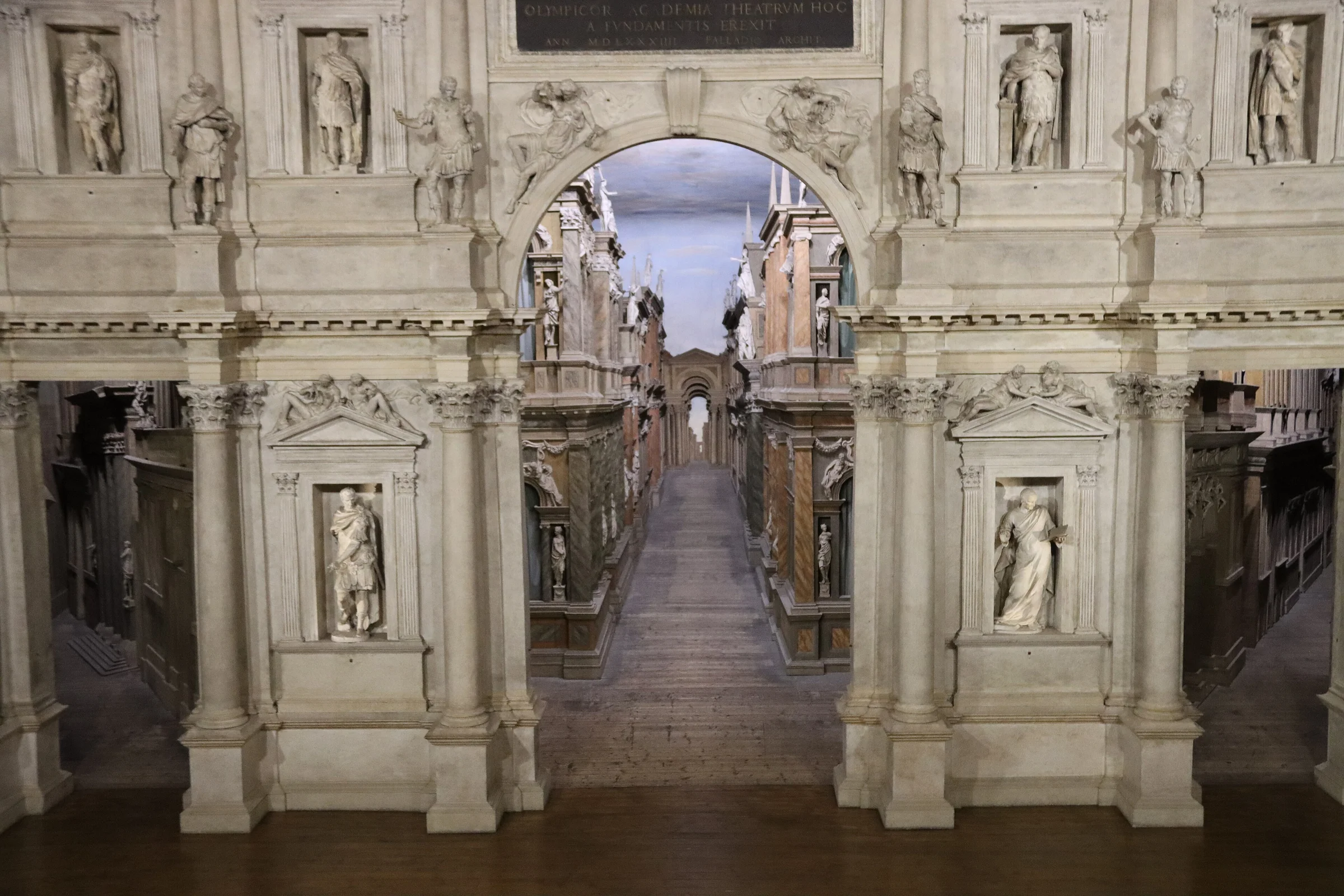
No other city wears one architect's signature the way Vicenza wears Andrea Palladio's. In the sixteenth century he reshaped its centre with palaces, public buildings and a theatre, and the influence that radiated out from here went on to shape façades from London to Washington. That legacy is recognised formally: the historic centre and the surrounding country houses together form the UNESCO World Heritage Site known as the City of Vicenza and the Palladian Villas of the Veneto. Walking the streets is less like visiting a museum than moving through a working textbook of proportion, symmetry and the classical orders. The compact old town sits between the Bacchiglione and Retrone rivers, and almost everything a first-time visitor wants to see lies within a fifteen-minute stroll. The spine of it all is the Corso Palladio, the arrow-straight main street that runs the length of the centre, lined with palace fronts and passing within a few steps of the Basilica Palladiana and Piazza dei Signori. At its eastern end, on Piazza Matteotti, stands the Teatro Olimpico, the theatre Palladio designed as his final work and did not live to see completed. Because the centre is so walkable, Vicenza rewards the traveller who slows down: the pleasure is in the accumulation of one refined building after another, in courtyards glimpsed through open doors, and in the way the same hand seems to have touched a civic hall, a private palazzo and a stage set within a few hundred metres. A day here is enough to feel the shape of it; two days let you breathe. The theatre is the natural anchor, and everything else in this guide clusters around it.
From the theatre to the museums
The Teatro Olimpico rarely travels alone. Two museums sit close enough to fold into the same visit, and both deepen what you have just seen inside the theatre. The Palladio Museum occupies Palazzo Barbaran da Porto, itself one of the master's designs, a short walk from Piazza Matteotti. It is devoted entirely to Palladio's work: drawings, wooden models of his buildings, and displays that explain how a mason's son became the architect whose ideas were copied for centuries. Standing before a model of the Teatro Olimpico or Villa La Rotonda after visiting the real thing turns a beautiful building into an intelligible one, and it is the single best place to understand the man whose city you are walking through. A few minutes away, across the handsome Piazza Matteotti from the theatre, stands Palazzo Chiericati, the city's civic art gallery. The palace is another Palladio design, with a colonnaded front that alone justifies the crossing of the square, and inside it holds Vicenza's municipal picture collection, ranging across the centuries with strong Venetian and local painting. For a visitor who has come for the theatre, the gallery is a graceful way to spend the part of a day when a single monument is not quite enough. Because the two museums bracket the Teatro Olimpico geographically, a natural rhythm suggests itself: theatre first, when the light is good and the crowds are thin, then the art gallery just opposite, then the Palladio Museum a little further into the centre to tie the threads together. Opening days and hours for the museums vary and change with the season, so it is worth confirming each on the day you plan to go; all three sit within easy walking distance of one another, so no transport is needed between them.
The civic heart: Basilica Palladiana and Piazza dei Signori
Midway along the Corso Palladio, the street opens onto Piazza dei Signori, the great civic square that has been the stage of Vicenza's public life for centuries. Dominating it is the Basilica Palladiana, and the name misleads English speakers: this is not a church but the city's medieval assembly hall, which the young Palladio wrapped in a shimmering double loggia of white stone. The commission made his reputation. The rhythmic arches, later known as the Palladian motif or serliana, march around the older building and turn a municipal hall into one of the most admired public façades in Europe. Above it rises the tall, verdigris-roofed council chamber, and beside it the slender Torre Bissara reaches high over the rooftops. The Basilica hosts exhibitions and events, and its upper loggia offers views across the terracotta roofscape; when it is open, the terrace is one of the finest free vantage points in the city, though access depends on the current programme. The square itself is framed by cafés and by the two tall columns that echo Venice's own, a reminder that Vicenza spent centuries within the Venetian Republic. This is the place to pause: order a coffee, or in the early evening an aperitivo, and watch the light move across Palladio's stonework. From here the Corso Palladio continues in both directions, so the square works as a hinge in any walking route, an easy point to break between the theatre at the eastern end and the shops, churches and palace fronts that fill the rest of the centre. Directly opposite the Basilica stands the Loggia del Capitaniato, another Palladio work, so the two sides of the piazza set his early and late civic styles face to face across the same paving.
The villas beyond the walls
Palladio's genius did not stop at the city gates. On a low hill just south-east of the centre stand two of the most famous country houses in the world, close enough to reach on the same day as the theatre and, for many visitors, the emotional high point of a trip to Vicenza. Villa Almerico Capra, universally known as La Rotonda, is Palladio's most perfect and most imitated design: a square block crowned by a dome, with an identical temple-front portico on each of its four sides, set so that it commands the countryside in every direction. Nothing else in the canon is quite so serene, and its echoes can be traced in country houses and public buildings across the English-speaking world. A few minutes' walk away is the Villa Valmarana ai Nani, a different pleasure altogether: a more intimate house celebrated for its interiors, frescoed by Giovanni Battista Tiepolo and his son Giandomenico in the eighteenth century, and named for the stone dwarfs that line its garden wall. Seeing the two together contrasts Palladio's cool geometry with the warmth and theatre of Venetian fresco painting. Both sit on the edge of the city and can be reached on foot by energetic walkers, by a short taxi or bus ride, or as part of a guided excursion; the classic approach is the leafy path up to the hilltop that also passes the Basilica di Monte Berico. Opening days for the villas are seasonal and each keeps its own schedule, with some interiors open only on particular days, so check before you set out. If your time is short, La Rotonda alone is worth the pilgrimage; if you have an afternoon, pair it with the Valmarana frescoes and treat the walk itself as part of the visit.
How the Vicenza City Card ties it together
Because so many of Vicenza's headline sights are run together as civic museums, there is a single card that bundles them. The Teatro Olimpico has its own standalone ticket, and you never need a card to enter the theatre; but if you intend to see more than the stage, a combined museum card is the tidier way to do it. The version we arrange covers the Teatro Olimpico together with the Palladio Museum, the civic art gallery at Palazzo Chiericati and the city's other civic museums, and it is valid across several days rather than a single visit. That makes it a natural fit for the itineraries in this guide: one purchase covers the theatre, the art gallery directly across Piazza Matteotti and the Palladio Museum a few streets away, with no need to queue separately at each. We sell the theatre entry on its own at a fixed per-person rate, and the combined card at a fixed per-person rate for those who want the wider set; both are booked in advance and delivered to your phone. Deciding between them is simple. If the theatre is the one thing you have come to Vicenza to see, the standalone entry is all you need. If you are giving the city a full day and want the museums as well, the card usually earns its place once you visit two or three sites, and its multi-day validity means you can split them across a morning and an afternoon, or across two days, without buying again. Whichever you choose, entry to the Teatro Olimpico is valid for the date you select rather than a fixed time slot, so you keep the freedom to plan the rest of the day around it.
A half-day plan around the theatre
If Vicenza is a stop between Venice, Verona and Padua, half a day is enough to see its greatest things without hurrying. The city sits on the main railway line, roughly twenty-five minutes from Padua and about forty-five from Venice or Verona, and the station is a ten-minute walk from the centre. Aim to arrive mid-morning. From the station, walk into the old town and pick up the Corso Palladio, letting it lead you the length of the centre. Give yourself a slow first pass, then head straight for the Teatro Olimpico on Piazza Matteotti at the eastern end while you are fresh; the fixed perspective stage set rewards an unhurried look, and mornings are usually the calmest time inside. Because your entry is valid for the whole day rather than a set time, you can adjust the exact hour to your train without anxiety. When you come out, cross the square to Palazzo Chiericati and spend half an hour with the civic art collection. Walk back along the Corso toward Piazza dei Signori, and break there for coffee beneath the Basilica Palladiana, taking in the loggia that made Palladio's name. If a few minutes remain before your train, the Palladio Museum sits just off the main street and can be looked into quickly, or saved for another visit. This route asks nothing of you but comfortable shoes: everything named here lies within a fifteen-minute walk, there is no transport to arrange, and the whole loop returns you naturally toward the station. Book the theatre entry ahead of time so the one ticketed step of the morning is already in your pocket, shown from your phone at the door, and the rest of the half-day stays gloriously unstructured.
A full day in the city of Palladio
With a full day, Vicenza opens up and the villas come within reach. Begin early in the historic centre and go straight to the Teatro Olimpico while the light is soft and the rooms are quiet; the theatre is at its most atmospheric before the day fills up. From Piazza Matteotti, cross to Palazzo Chiericati for the civic gallery, then walk a few streets to the Palladio Museum in Palazzo Barbaran da Porto, where the models and drawings make sense of everything you are seeing outside. That trio of sights sits comfortably inside a single morning and is exactly what the combined city card is built to cover. Break for lunch around Piazza dei Signori, in the shadow of the Basilica Palladiana, and give yourself time on the square before moving on. Devote the afternoon to the villas on the city's south-eastern edge. Make for Villa La Rotonda, Palladio's four-fronted masterpiece, and then walk the short distance to the Villa Valmarana ai Nani for its Tiepolo frescoes; the two together are the perfect counterpoint to a morning of civic architecture. Energetic walkers can reach the hill on foot by the path that also climbs to the Basilica di Monte Berico, with its long views back over the rooftops; others will prefer a short taxi or a guided excursion. Because villa opening days are seasonal and each keeps its own hours, confirm them when you plan, and let their schedule set the shape of your afternoon. Return to the centre for an aperitivo as the stone turns gold in the low sun. A day arranged this way moves outward from the theatre in widening circles, from a single room to a whole landscape, and leaves you with the clearest possible sense of why this quiet Veneto city carries Palladio's name.
Frequently asked
Do I need the Vicenza City Card to visit the Teatro Olimpico?
No. The Teatro Olimpico has its own standalone ticket, and it is all you need to enter the theatre. The combined city card, which also covers the Palladio Museum and the civic art gallery, is only worth considering if you plan to visit several museums during your stay.
How do I get from the train station to the Teatro Olimpico?
It is an easy walk of about ten minutes. From Vicenza station, head into the old town and follow the Corso Palladio, the main street, all the way to its eastern end at Piazza Matteotti, where the theatre stands. Everything else in the centre lies along or just off that same street.
Can I see the Palladian villas on the same day as the theatre?
Yes. Villa La Rotonda and the Villa Valmarana ai Nani sit just outside the centre, on the south-eastern edge of the city, and pair well with a morning at the theatre and museums. Their opening days are seasonal and each keeps its own schedule, so confirm hours before you set out.
Is my Teatro Olimpico entry for a fixed time slot?
No. Entry is valid for the date you choose rather than a specific time, so you can enter any time within opening hours on your chosen day. This makes it easy to plan the rest of Vicenza around the theatre, whether you have half a day or a full one.
How much time should I set aside for Vicenza?
Half a day is enough for the Teatro Olimpico, the civic art gallery opposite and a walk to Piazza dei Signori and the Basilica Palladiana. A full day lets you add the Palladio Museum and the villas on the city's edge, La Rotonda and the Villa Valmarana ai Nani.