 Skip-the-line available
 How to Visit the Teatro Olimpico in Vicenza
Opening hours, the best time to go, what to look for inside, how long to allow, and the simple walk from Vicenza station to the door.
The Teatro Olimpico is a small marvel that rewards a little planning. Here is everything you need to arrive relaxed and unhurried, from opening hours to the ten-minute walk from the station.
Opening hours and when to arrive
The Teatro Olimpico keeps steady, dependable hours, and knowing them in advance saves you the one genuine pitfall of a Vicenza visit. The theatre is generally open Tuesday to Sunday, roughly from 09:00 to 17:00, with the closing time extended later in the summer months when the city fills with visitors and evening light lingers. It is closed on Mondays, so build your itinerary around that if you are passing through at the start of the week, and it also closes on a handful of public holidays through the year. Because those seasonal and holiday variations do shift, it is always worth confirming the exact hours for your chosen date when you book rather than assuming a fixed timetable. Last entry falls shortly before the doors close, and this matters more here than at a larger site. The Teatro Olimpico is compact and quiet, and a rushed final entry gives you no time to settle into the auditorium and let your eyes travel down the painted streets of the stage. To do the place justice, aim to arrive at least an hour before closing, and ideally longer. If you are combining the theatre with the civic museums on a single card, treat mid-morning as your natural anchor point: you can start at the theatre when it is calm, then move on to the Palladio Museum and Palazzo Chiericati while the day is still ahead of you. Morning visits also tend to be the coolest and least crowded, particularly in high summer. Whatever slot you choose, there is no need to pin yourself to a precise minute of arrival, which is one of the quiet pleasures of visiting here, and something the next section explains in full.
The best time to visit
The Teatro Olimpico never draws the crushing queues of Italy's headline sites, which is part of its charm, but a little timing still makes the difference between a good visit and a memorable one. The quietest, most atmospheric window is the first hour or two after opening, when the auditorium is hushed and you can stand in the cavea almost alone, taking in the sky-painted ceiling and the receding stage without a crowd shuffling past. Late afternoon, an hour or so before closing, is the other sweet spot, once the mid-day day-trippers have moved on toward Venice or Verona. The middle of the day, roughly late morning to early afternoon, is the busiest stretch, especially at weekends and across the summer season. Season shapes the experience too. Spring and early autumn are ideal: the city is comfortable to walk, the light is generous, and Vicenza's palaces and squares look their best on the stroll to and from the theatre. Summer brings longer opening hours and warm evenings, but also the highest visitor numbers and real heat in the historic centre, so an early start pays off doubly. Winter is genuinely peaceful, and the interior, being roofed and enclosed, is a pleasure to explore whatever the weather outside. One thing worth checking whenever you go: the Teatro Olimpico remains in occasional use for performances, so on some dates parts of it may be given over to rehearsals or events. That is rare, but if you have a single fixed day in the city it is another good reason to confirm access for your date when you book. For most visitors, a weekday morning in the shoulder seasons is the unhurried, well-lit ideal.
What you'll see inside
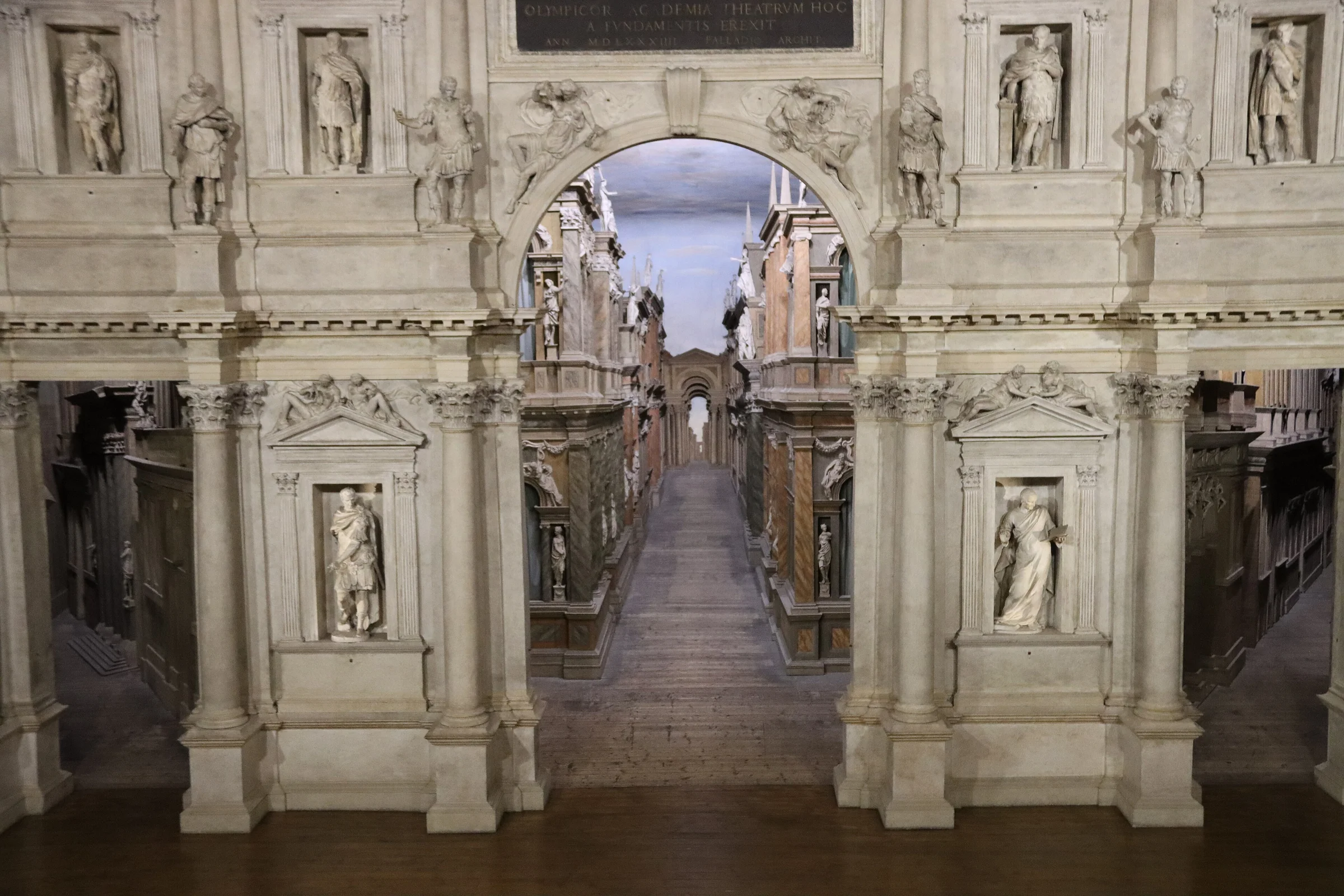
Nothing quite prepares you for the moment you step into the auditorium. The Teatro Olimpico is the oldest surviving indoor theatre in the world and one of only three surviving Renaissance theatres, and it was the final work of Andrea Palladio, begun in 1580 and completed after his death that same year by his pupil Vincenzo Scamozzi. The room you enter is a semi-elliptical, Roman-style cavea of tiered wooden seating, modelled on the open-air theatres of antiquity but drawn indoors and roofed over. Look up and the ceiling is painted as an open sky, so the whole space feels caught between a real building and a vision of the ancient world. Crowning the tiers is a colonnade lined with statues that ring the auditorium and give the room its theatrical grandeur. Then you turn to the stage, and the theatre delivers its masterstroke. Scamozzi's permanent set is a fixed, trompe-l'oeil construction in wood depicting the streets of the ancient city of Thebes, built for the 1585 inaugural production of Sophocles' Oedipus the King. Using forced perspective, the streets appear to plunge far into the distance, though in reality the receding scenery is remarkably shallow, an illusion the eye simply refuses to abandon. It is the oldest surviving stage set in the world, still standing where it was first raised more than four centuries ago. Take a moment to move a few steps to either side and watch the sightlines down each street shift as your angle changes, which is the whole trick of the perspective. Between the sky above, the statues around you and the impossible streets ahead, the Teatro Olimpico packs an extraordinary amount into one modest room, and it is a place that rewards slow, attentive looking rather than a quick circuit.
How long to allow
The Teatro Olimpico is not a sprawling site, and that is a virtue. For the theatre itself, allow around forty-five minutes to an hour. That is enough time to settle into the cavea, take in the painted ceiling and the statue colonnade without hurrying, study the perspective of the stage set from a few different angles, and read the interpretation that puts the room in its Renaissance context. Rushing it in fifteen minutes is possible but misses the point; the pleasure here is in lingering, in letting the illusion of the streets of Thebes work on you rather than glancing and moving on. Photographers and architecture enthusiasts can happily spend longer. If you are visiting on a combined museum card that also covers the Palladio Museum, Palazzo Chiericati and the other civic museums, plan for a half-day rather than an hour. The Palladio Museum, devoted to the architect whose city this is, and Palazzo Chiericati, the civic art gallery housed in one of Palladio's own buildings, each deserve an unhurried hour or so, and they sit within an easy walk of the theatre in the historic centre. Add the stroll along the Corso Palladio, a coffee in Piazza dei Signori beside the Basilica Palladiana, and lunch, and you have a rich, full day built around the theatre without ever feeling stretched. A practical tip: because the theatre is compact and the museums are close by, you do not need to rigidly schedule each one. Start at the Teatro Olimpico when it is calm, then let the rest of the day unfold at its own pace. If your time in Vicenza is limited to a single sight, the theatre alone repays the trip; if you have the day, the wider Palladian city is one of the most rewarding in the Veneto.
How entry works: date-valid, not a fixed time slot
One detail makes visiting the Teatro Olimpico refreshingly low-stress: entry is date-based, not tied to a timed slot. Your ticket is valid for the calendar date you choose, and you may enter at any point within opening hours on that day. There is no fixed appointment to miss and no penalty for arriving a little later than planned, which is a real relief if you are travelling in by train and cannot promise your connection to the minute. It also means you can shape your day freely: see the theatre first thing, or drift in during a quiet late afternoon, entirely as it suits you. Booking ahead is still worth doing, and not for a time slot but for certainty. Securing your date in advance means the visit is settled before you arrive, you skip the on-site ticket-buying step, and you go straight to the entrance. When you book through our concierge service, your ticket is delivered as a mobile or print-at-home e-ticket; you simply show your smartphone at the entrance, or bring a printout if you prefer. There is no need for a combined museum card to enter the Teatro Olimpico, as it has its own standalone ticket. If you would like more of Palladio's city, a combined Vicenza card covering the theatre plus the Palladio Museum, Palazzo Chiericati and other civic museums is also available. A note on eligibility: EU citizens under 18 enter free, so families should factor that in. Reduced rates for certain other visitors are handled only at the on-site ticket office rather than online, so our booking covers the full adult admission and the under-18-free allowance. As with any concierge arrangement, we book and arrange the ticket on your behalf so the practical side is taken care of before you set foot in Piazza Matteotti.
Photography, accessibility and practicalities
Photography is one of the great temptations of the Teatro Olimpico, and understandably so. Visitors generally take photographs for personal use, though the use of flash and of tripods is typically discouraged to protect the historic interior and to keep the space calm for everyone; as norms can be set locally and change for events, it is sensible to check any posted guidance when you arrive and to follow the direction of on-site staff. For the best results you will not need a flash anyway: the auditorium's soft light and the depth of the stage set reward a steady hand and a moment's patience far more than a burst of artificial light. Move to the centre of the cavea for the classic head-on view straight down the perspective streets, then step to the sides to catch how the illusion changes. On accessibility, the theatre occupies a historic sixteenth-century building, so some features reflect its age, including tiered wooden seating in the auditorium. Step-free routes and assistance may be available, but arrangements can vary, so if anyone in your party has specific mobility needs it is best to confirm what is possible for your visit in advance rather than assuming full step-free access throughout. Practically, the theatre is enclosed and roofed, which makes it a dependable choice in any weather and a welcome cool retreat on a hot Veneto afternoon. Large bags may need to be left at the entrance, facilities are modest in keeping with the building's scale, and the surrounding historic centre is comfortably walkable and well supplied with cafés for before or after. Keep your e-ticket handy on your phone as you approach, allow a few unhurried minutes at the entrance, and you will be inside and looking up at that painted sky in no time.
Getting there
The Teatro Olimpico could hardly be easier to reach. It stands in Piazza Matteotti, at the eastern end of Vicenza's compact historic centre, and the walk from the railway station takes only about ten minutes. From the station you head into the old town and follow the Corso Palladio, the handsome main street that runs the length of the centre and is lined with the palaces that earned the city its Palladian fame. The Corso delivers you almost to the theatre's door, so the approach is itself part of the experience, an unhurried stroll past Renaissance façades rather than a slog across a modern city. Vicenza sits on the main railway line between Milan and Venice, which makes it a genuinely easy day trip from across the Veneto and beyond. Trains run frequently, and journey times are short: roughly 25 minutes from Padua, and about 45 minutes from either Venice or Verona. That puts the Teatro Olimpico comfortably within reach as a half-day or full-day outing from any of those cities, with no need for a car. If you do drive, be aware that Vicenza's historic centre has restricted traffic zones, so park at the edge of the centre and walk in; the historic core is best explored on foot in any case. Once you are in Piazza Matteotti you are perfectly placed for the rest of Palladio's city, with Palazzo Chiericati beside the theatre, the Palladio Museum a short walk away, and the Basilica Palladiana and Piazza dei Signori a little further along the Corso. Just outside town lie two of Palladio's most celebrated works, the Villa La Rotonda and the nearby Villa Valmarana ai Nani, if you want to extend a day in the theatre into a fuller pilgrimage through the architecture of the Veneto.
Frequently asked
Do I need to choose a time slot when I book?
No. Entry to the Teatro Olimpico is date-based, not timed. Your ticket is valid for the date you choose, and you can enter any time within opening hours that day. There is no fixed appointment to keep, which makes it easy if you are arriving by train.
How long should I plan for a visit?
Allow around 45 minutes to an hour for the theatre itself, which is enough to enjoy the auditorium, the painted ceiling and the perspective stage without rushing. If you add the Palladio Museum and Palazzo Chiericati on a combined card, plan for a relaxed half-day instead.
Is the Teatro Olimpico open on Mondays?
Generally no. The theatre is usually open Tuesday to Sunday, roughly 09:00 to 17:00 with longer hours in summer, and closed on Mondays and some public holidays. Because seasonal and holiday hours vary, it is worth confirming the exact times for your chosen date when you book.
Can I take photographs inside?
Visitors generally take photos for personal use, though flash and tripods are usually discouraged to protect the historic interior. Guidance can vary and change for events, so check any posted signs and follow staff direction. The soft interior light means you rarely need a flash anyway.
How do I get to the theatre from Vicenza station?
It is about a ten-minute walk. From the station, follow the Corso Palladio through the historic centre to Piazza Matteotti at its eastern end, where the theatre stands. Vicenza is roughly 25 minutes by train from Padua and about 45 minutes from Venice or Verona.